
Every serum on the market promises something — deep hydration, a brighter tone, fewer fine lines. What separates a serum that delivers from one that merely sits on the shelf is not marketing. It is whether the right active ingredient was chosen, whether it was formulated at an effective concentration and pH, and whether the factory behind it had the R&D depth to make it stable.
This guide walks through the major serum ingredient categories and what each one actually does — then explains, from a manufacturer’s point of view, how to brief your factory so you get the effect you want, and how to judge whether a factory can really deliver it.
The Ingredient-to-Benefit Map at a Glance
Before diving into the science, here is the practical map most brand owners need: which ingredients target which concern, and what formulation knowledge is required to make them work.
| Ingredient | Primary Benefit | Typical Use Level | Formulation Note |
|---|---|---|---|
| Hyaluronic Acid | Hydration, plumping | 0.1–2% | Multi-molecular-weight blends outperform single grades |
| Glycerin | Hydration (humectant) | 3–10% | Reliable workhorse; pairs with everything |
| Ceramides (NP/AP/EOP) | Barrier repair | 0.5–2% | Needs cholesterol + fatty acids in a 3:1:1 ratio |
| Centella Asiatica | Soothing, redness relief | 0.2–2% | Madecassoside content determines real activity |
| Vitamin C (L-AA) | Brightening, antioxidant | 5–20% | pH below 3.5; unstable — airless or opaque packaging required |
| Niacinamide | Brightening, oil control, barrier | 2–5% | Above 5% irritation risk rises without supporting actives |
| Tranexamic Acid | Dark spot reduction | 2–3% | Excellent with niacinamide for post-acne marks |
| Retinol | Wrinkles, cell turnover | 0.1–1% | Encapsulation improves stability and tolerance |
| Peptides | Firmness, fine lines | 2–8% | Signal peptides are gentle; watch formulation incompatibilities |
| Salicylic Acid | Pore clearing, oil control | 0.5–2% | Oil-soluble BHA; pH 3–4 for activity |
| Vitamin E + Ferulic Acid | Antioxidant network | 0.5–1% / 0.5% | Ferulic acid stabilizes vitamins C + E |
Now let us look at each category in more depth — because knowing the ingredient is only half the story. How it is formulated is what your customers will actually feel.
Hydration and Barrier Repair: Hyaluronic Acid, Glycerin and Ceramides
Hyaluronic acid can bind up to 1,000 times its weight in water, which is why it anchors almost every hydrating serum. The detail most buyers miss: molecular weight matters more than percentage. High molecular weight HA forms a moisture film on the surface; low molecular weight HA penetrates deeper. A well-built serum blends three to five molecular weights. A single-grade 2% HA serum can actually feel tight and drying in dry climates, because pure humectants pull water out of the skin when ambient humidity is low.
Glycerin is unglamorous but irreplaceable — the most proven humectant in cosmetic science. Panthenol (pro-vitamin B5) adds both hydration and a soothing effect, which is why it appears in sensitive-skin lines.
For compromised barriers, ceramides are the structural answer. Skin lipids are built from ceramides, cholesterol and fatty acids in roughly a 3:1:1 ratio — a serum that only adds ceramides without the supporting lipids delivers far less. This is exactly the kind of knowledge that separates a formulator from a filler.
If hydration is your category, see how we build dedicated products as a hydrating serum manufacturer.
Soothing Actives for Sensitive Skin: Centella, Allantoin and Panthenol
Centella asiatica became the flagship calming ingredient of the K-beauty wave, and the science supports the reputation: its active fractions, madecassoside and asiaticoside, visibly reduce redness and support skin recovery. But the raw material grade matters enormously — extracts with low madecassoside content are little more than colored water with a trendy name.
Allantoin and bisabolol are the quiet supporting cast: inexpensive, extremely well tolerated, and effective at reducing the sting factor of stronger actives. In a well-designed soothing serum, they are what allow higher actives like niacinamide or vitamin C to stay comfortable on reactive skin.
The formulation question for a soothing serum is always the same: is the calming system strong enough to offset the actives around it? A factory that cannot answer that question precisely cannot build a true sensitive-skin line.
Brightening: Vitamin C, Niacinamide and Tranexamic Acid
Vitamin C exists in two worlds. Pure L-ascorbic acid is the most potent and best studied, but it is fragile: it needs a pH below 3.5, degrades on contact with light and air, and therefore demands airless or opaque packaging and tight process control. Derivatives — sodium ascorbyl phosphate, ethyl ascorbic acid, ascorbyl glucoside — trade some potency for dramatically better stability and skin tolerance. Choosing between them is a positioning decision: maximum performance with shorter shelf life, or stable elegance with a gentler profile.
Niacinamide at 2–5% is the best multitasker in the industry: it fades pigmentation, strengthens the barrier, and regulates sebum at the same time. Above 5%, flushing and irritation become common unless the buffer system is well built. Tranexamic acid at 2–3% has become the go-to for post-inflammatory dark spots, and pairs beautifully with niacinamide.
One regulatory note buyers often overlook: claims language differs by market. “Brightening” and “evens skin tone” travel globally; “whitening” is restricted in the EU. A competent factory will flag this before you ask. We cover this on our whitening serum manufacturing page.
Anti-Aging: Retinol, Peptides and Bakuchiol
Retinol remains the gold standard for wrinkles, backed by decades of clinical literature. It is also the most demanding ingredient a serum lab will ever handle: it oxidizes easily, tolerates a narrow pH window around 5.5–6, and irritates unprepared skin. Modern solutions are encapsulated retinol (improves both stability and tolerance) and gentler derivatives like retinaldehyde and retinyl palmitate. Packaging is not optional — a retinol serum in a clear dropper bottle is dead on arrival.
Peptides are the gentle alternative: signal peptides such as Matrixyl support collagen synthesis without the retinol sting, and work especially well in firming eye products. They demand formulation discipline — peptides clash with certain preservative systems and charged actives. Bakuchiol, a plant-derived retinol alternative, has carved out a strong position in clean-beauty lines.
The classic mistake we see from new brands: wanting vitamin C, retinol and exfoliating acids in one bottle. A good formulator will talk you out of it and into a routine architecture instead — often a morning antioxidant serum paired with a night retinol serum. Explore how we structure these as an anti-aging serum manufacturer.
Oil Control and Antioxidant Defense
For oily and combination skin, salicylic acid (an oil-soluble BHA at 0.5–2%) clears inside the pore, where water-soluble actives cannot reach. Zinc PCA moderates sebum production without stripping. And niacinamide — again — earns its place as the bridge ingredient that controls oil while reinforcing the barrier.
Antioxidant serums protect rather than correct. Vitamin E and ferulic acid famously stabilize vitamin C in the classic C-E-ferulic architecture, extending both shelf life and on-skin performance. Resveratrol and CoQ10 add plant-derived and mitochondrial-level antioxidant stories respectively. These serums live or die on oxidation control during manufacturing — nitrogen blanketing and low-temperature processing are the difference between a serum that is still active in month twelve and one that turned amber in month three. See our antioxidant serum manufacturing page for how we handle this.
One Ingredient Is Not a Formula: What Really Determines Efficacy
Here is the uncomfortable truth of the serum category: two factories can use the same 10% vitamin C and produce products that perform completely differently. Efficacy is determined by four factors the ingredient list will never show you:
- Concentration discipline — more is not better. Niacinamide above 5% often creates irritation faster than results; retinol above 0.5% needs serious mitigation work. The dose makes the medicine.
- pH architecture — vitamin C wants below 3.5, retinol wants 5.5–6, peptides prefer near-neutral. Combine them carelessly and you deactivate both.
- Stability engineering — encapsulation, chelators, antioxidant networks, airless packaging, nitrogen blanketing. This is invisible on the label and decisive in month six.
- Sensory design — slip, absorption speed, tackiness, fragrance load. Customers repurchase texture more reliably than efficacy.
This is why “which ingredient” is the wrong first question to a factory. The right question is: “How will you make this ingredient deliver this effect, at this price, on this timeline?” Which leads to the next two sections: how to brief, and how to judge.
How to Brief Your Serum Manufacturer So You Get the Effect You Want
Most failed serum projects die in the briefing stage — not because the factory was incapable, but because the brief was vague. “I want a hydrating serum” produces a commodity. A strong brief looks like this:
- 1. Target market and claims. US, EU, Middle East, Southeast Asia — each has different regulatory constraints on what you can print on the box. State the market first, and the claim language second.
- 2. The measurable effect. Not “hydrating” but “visible hydration improvement within 8 hours of application, verified by corneometer.” Not “anti-wrinkle” but “reduces the appearance of fine lines around the eyes in 8 weeks.” A factory that can commit to a measurable target is telling you it has testing capability.
- 3. Hero ingredient and its constraints. Name the active and its percentage band, and say whether you are open to derivatives. “Vitamin C, open to stable derivatives” gets a better answer than “the strongest vitamin C you have.”
- 4. Texture and sensory benchmark. Send a reference product. “Absorbs in 30 seconds, no tack, silicone-free slip” is a brief; “nice texture” is a gamble.
- 5. Packaging architecture. Dropper, airless pump, sachet or ampoule — decided early, because it constrains the formula (oxidation-sensitive actives rule out clear droppers).
- 6. Certifications. Vegan, cruelty-free, fragrance-free, alcohol-free, or specific free-from lists — these reshape the formula from the first draft.
- 7. MOQ and price band. An honest target price per unit at your MOQ lets the chemist design to a cost, instead of designing something beautiful you cannot afford.
- 8. Timeline. Launch date, first sample date, and how many revision rounds you can afford.
A factory that responds to this brief with specific, technical follow-up questions is a factory worth pursuing. A factory that answers “no problem, we send sample” to everything is a factory worth avoiding.
How to Judge Whether a Factory Can Actually Deliver
Before committing, run every candidate through these eight checks. They take one or two rounds of communication each, and they filter out the majority of problem suppliers.
- 1. In-house chemists, not just a filling line. Ask how many formulators are on staff and whether they develop from scratch or only fill existing bases. True ODM capability shows in the vocabulary of the reply.
- 2. They ask about pH, stability and compatibility unprompted. If their first questions concern your actives’ stability and packaging, they have real formulation experience.
- 3. Stability and challenge testing. Ask to see a sample stability report: accelerated testing at 45°C, freeze-thaw cycles, microbial challenge testing. No report, no reliability.
- 4. Raw material provenance. Can they trace actives to authorized suppliers (BASF, DSM, Croda, Symrise tier) and provide a COA for the specific batch? Grey-market actives are the dirty secret of cheap serums.
- 5. Sampling speed and revision policy. Seven to ten working days to first sample, and a clear policy on how many free revision rounds you get. Slow sampling usually means outsourced labs.
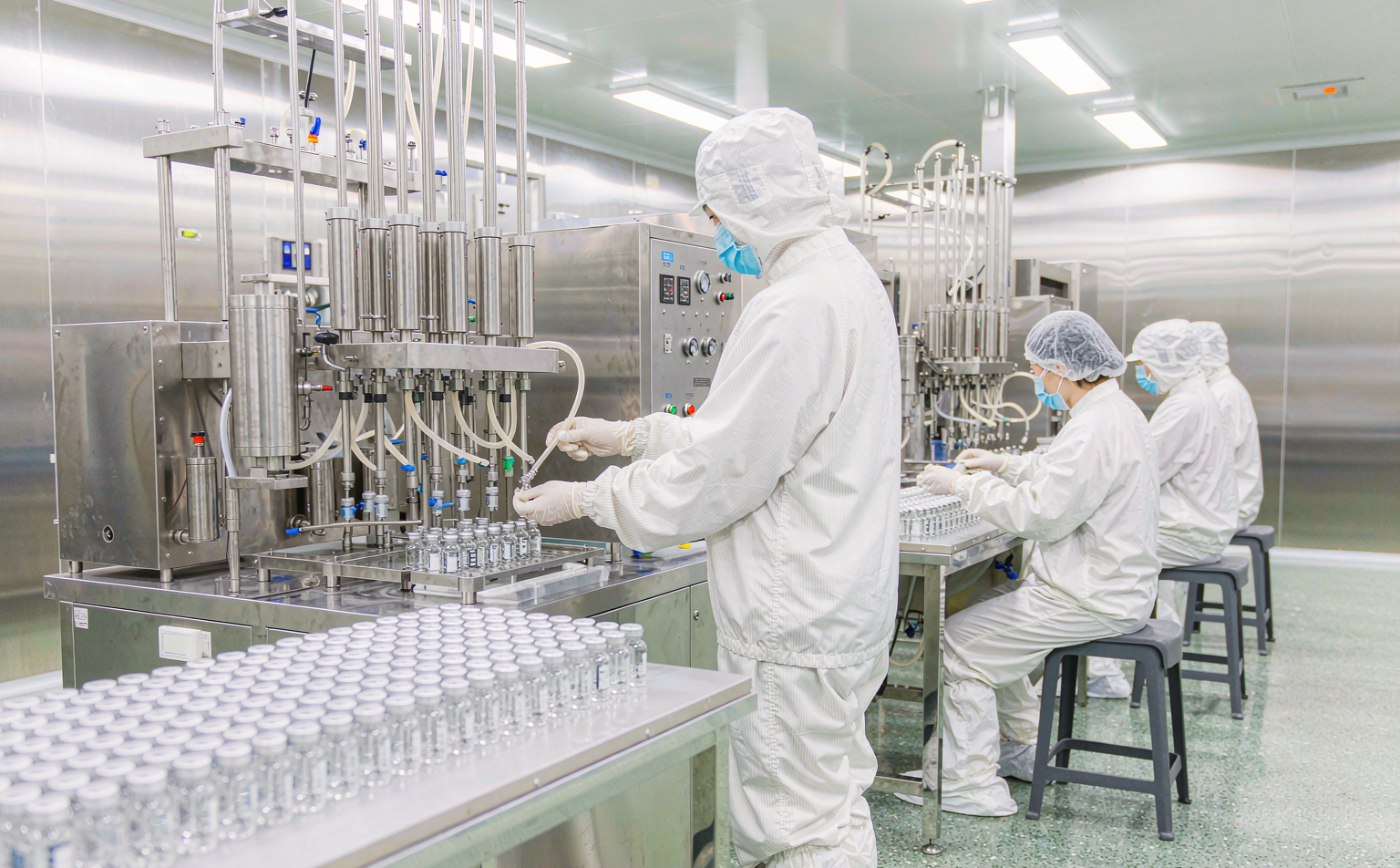
- 6. Cleanroom class and filling capability. For serums, ask specifically about their cleanroom grade and whether they can handle airless filling, ampoules and freeze-dried formats.
- 7. Documentation completeness. MSDS, COA, stability data, ingredient certifications, and export documents for your market. A factory that stumbles here will stumble at customs too.
- 8. Communication quality. Vague answers, identical replies to different questions, and no willingness to discuss trade-offs are the clearest early warning signs.
How Ucare Delivers Targeted Serums
We put this checklist to ourselves before we put it to anyone else. Ucare Biotechnology operates a 10,000 m² production base in Qingyuan, Guangdong, with 100,000-class cleanrooms and an in-house R&D laboratory — which means formulation, stability testing and sampling all happen under one roof, not across three subcontractors.

On the ingredient side, our chemists build serums around the actives described above — multi-molecular-weight hyaluronic acid systems, stabilized vitamin C in airless packaging, encapsulated retinol, peptide complexes and tranexamic acid blends — and we tell you honestly when a requested combination will not survive stability testing. We hold 8+ formulation patents and draw on 13 owned botanical planting bases for traceable plant extracts, which matters especially for soothing and antioxidant lines.
For brand owners, the practical numbers: MOQ from 1,000 pcs per SKU, first samples in 7–10 working days, bulk production in 25–35 days, and full documentation (MSDS, COA, stability reports) for export to the US, EU, Middle East and Southeast Asia. More than 500 brands across 40+ countries have shipped with us.
Browse our full serum manufacturing capabilities — or start with the format explainer in our guide to what a facial serum actually is. If you already have a brief, send it; if you only have an idea of the effect you want, tell us the effect and we will design the ingredient system backward from it.
The Takeaway
Ingredients are the vocabulary of a serum, but formulation is the grammar. Knowing that hyaluronic acid hydrates and retinol smooths is table stakes — the real product is built in the decisions about molecular weight, pH windows, stabilization and sensory design. Choose a partner who can hold that whole system in their head, brief them with measurable targets, and test them with the eight-point checklist before you trust them with your launch. If you want a factory that enjoys that conversation, talk to Ucare.